Table Of Content
The lawsuit was filed in February, alleging the public funding violated the state Constitution in as many as five different ways and naming the state of Nevada, the governor and the state treasurer as defendants. A Nevada teachers’ union announced two challenges to the public funding, pursuing a referendum that would let voters decide and filing a lawsuit alleging the bill was unconstitutional. On Thursday, National Hockey League owners approved the relocation of the Arizona Coyotes to Salt Lake City.
Girl Scouts of San Gorgonio get grant for mountain camp near Idyllwild
It was founded by Ferdinand Palmo, who hoped to bring Italian opera back, after the failure of the Italian Opera House. There was one major problem with this 800-seat opera house—extremely hard benches with a slat across the back. These were very uncomfortable for the long operas and the upper classes were disappointed in the lack of luxury. Palmo did allow them to upholster their own benches or bring a pillow, but the opera house only lasted about two seasons. Anthony Davis (b. 1951) is an acclaimed improvisational jazz pianist, composer, and educator whose work draws upon several global musical traditions.
The Submarine Tour
The Metropolitan Opera has always engaged many of the world’s most important artists. Christine Nilsson and Marcella Sembrich shared leading roles during the opening season. In the German seasons that followed, Lilli Lehmann dominated the Wagnerian repertory and anything else she chose to sing. In the 1890s, Nellie Melba and Emma Calvé shared the spotlight with the De Reszke brothers, Jean and Edouard, and two American sopranos, Emma Eames and Lillian Nordica.
Satellite radio
Since the summer of 2006, Peter Gelb has been the Met’s general manager—the 16th in company history. Under his leadership, the Met has elevated its theatrical standards by significantly increasing the number of new productions, staged by the most imaginative directors working in theater and opera, and has launched a series of initiatives to broaden its reach internationally. These efforts to win new audiences prominently include the successful Live in HD series of high-definition performance transmissions to movie theaters around the world. To revitalize its repertoire, the Met regularly presents modern masterpieces alongside the classics. Starting with the 2018–19 season, Yannick Nézet-Séguin took the musical helm of the company as the Met’s Jeannette Lerman-Neubauer Music Director. In the Met's inaugural season of 1883–1884, Auguste Vianesi, who conducted most of the performances that season including the opening night, was listed in the playbills as "Musical Director and Conductor"; thereafter, the Met did not have another officially designated "music director" until Rafael Kubelík in 1973.
A Pathbreaking Singer Arrives at the Met, With Pearls and Tattoos - The New York Times
A Pathbreaking Singer Arrives at the Met, With Pearls and Tattoos.
Posted: Tue, 16 Apr 2024 07:00:00 GMT [source]
The Met: Live in HD
Kathleen Battle to Return to the Metropolitan Opera in May - OperaWire OperaWire - OperaWire
Kathleen Battle to Return to the Metropolitan Opera in May - OperaWire OperaWire.
Posted: Mon, 18 Mar 2024 07:00:00 GMT [source]
This nuanced atmosphere stirs and awakens into the story of the Nativity with Mary and Joseph. Conductor Marin Alsop masterfully maintained a permeating sense of wonder, making it easy for anyone to pick up on what was happening and why the libretto includes multiple perspectives. The 1892−93 season was canceled while the opera house was rebuilt along its original lines. The Vaudeville Club (which eventually became the Metropolitan Opera Club) was founded that season, hosting entertainment in the undamaged portions of the house. MetTitles are available in English, Spanish, and German for all opera performances, and in Italian for all Italian-language operas. Every spot in the opera house is outfitted with a small seat-back screen featuring subtitles in multiple languages, making it simple to follow along with the onstage action, regardless of whether the performers are singing in Italian, French, German, Russian, or Czech.
Edward Johnson
Among Wagner’s works, Die Meistersinger von Nürnberg, Das Rheingold, Siegfried, Götterdämmerung, Tristan und Isolde, and Parsifal were first performed in this country by the Met. Other American premieres have included Boris Godunov, Der Rosenkavalier, Turandot, Simon Boccanegra, and Arabella. An additional 78 operas have had their Met premieres since the opera house at Lincoln Center opened in 1966. Kevin Puts’s hit new opera, which played to sold-out audiences during its world-premiere production last season, triumphantly returns. The original trio of legendary divas—Renée Fleming, Kelli O’Hara and Joyce DiDonato—reprise their celebrated portrayals of three women from different eras whose lives intersect through the power of Viriginia Woolf’s Mrs. Dalloway. Select audience who do not live near a participating movie theater may have access to watch the Met’s transmissions live at home.
Public Tours
The all-star principal quartet also features Ailyn Pérez as Micaëla and bass-baritone Ryan Speedo Green as Escamillo, with Diego Matheuz on the podium. This rich mixture just about hangs together musically and dramatically, with only a few loose ends. Whatever the eventual fate of Girls of the Golden West in the opera houses of the world, it now has a definitive recording. John Adams’s fourth full-length opera was first performed in San Francisco in 2017. Then the music of Girls of the Golden West played for almost three hours, but after two reworkings – the first for the European premiere in Amsterdam in 2019, the second for the concert performances in Los Angeles last year on which this recording is based – it runs for just over two.
Upcoming Performances
But even for those who don’t give a fig for the endless debate over whether Maria Callas was the greatest Carmen, the history of the Met Opera house is a compelling story. It’s full of egos so big— divas, operatic and otherwise, like city planner Robert Moses, John D. Rockefeller III, Philip Johnson, Leontyne Price—that it’s a wonder they could all fit on the Upper West Side. The Met's experiments with television go back to 1948 when a complete performance of Verdi's Otello was broadcast live on ABC-TV with Ramón Vinay, Licia Albanese, and Leonard Warren. In the early 1950s the Met tried a short-lived experiment with live closed-circuit television transmissions to movie theaters. The first of these was a performance of Carmen with Risë Stevens which was sent to 31 theaters in 27 US cities on December 11, 1952. Beyond these experiments, however, and an occasional gala or special, the Met did not become a regular presence on television until 1977.
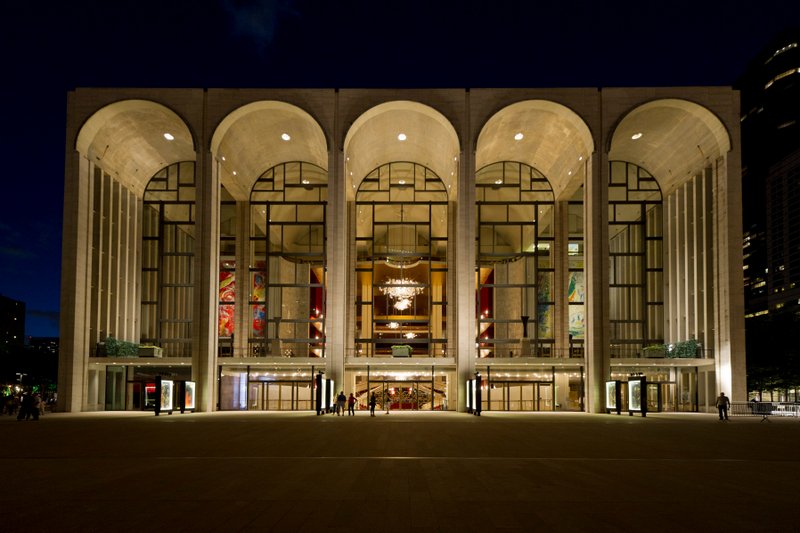
Planning for a new home for the Metropolitan Opera began as early as the mid-1920s, when the backstage facilities of the former house were becoming vastly inadequate for growing repertory and advancing stagecraft. As part of the development of the present-day Rockefeller Center site, there was to be a development with a new 4,000-seat opera house at its center. Financial problems and the following stock market crash of 1929 postponed the relocation of the Metropolitan Opera, and the complex became more commercial-based. Located at what is now Court and D streets, the opera house was built four years before Los Angeles had one of its own and was for many years perhaps the finest and most elaborate theater in Southern California.
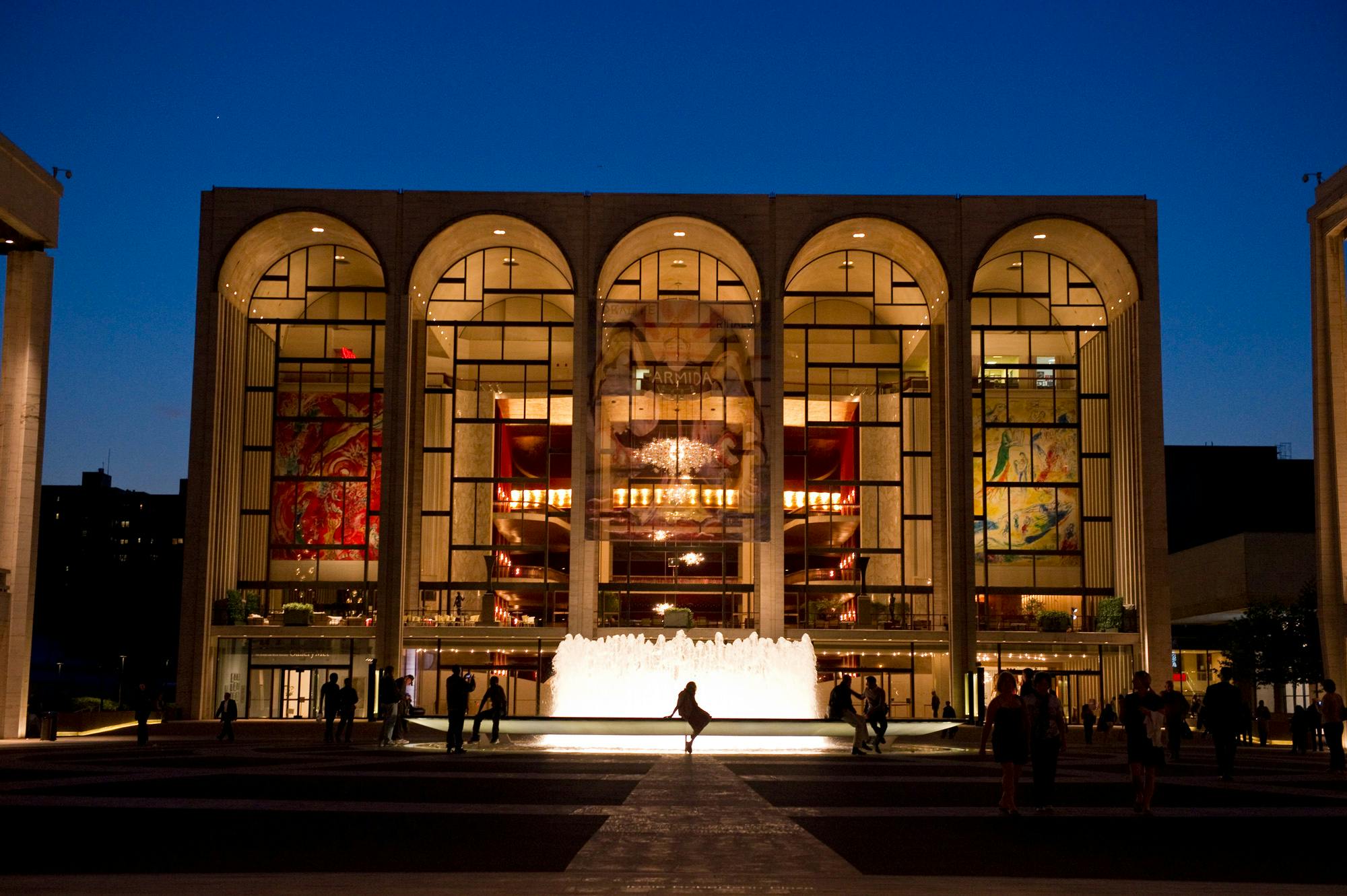
Various plans were put forward over the years to build a new home for the company and designs for new opera houses were created by various architects including Joseph Urban. Proposed new locations included Columbus Circle and what is now Rockefeller Center, but none of these plans came to fruition. Only with the development of Lincoln Center on New York's Upper West Side did the Met finally have the opportunity to build an adequate, modern opera house. During the 1983–84 season the Met celebrated its 100th anniversary with an opening night revival of Berlioz's mammoth opera Les Troyens, with soprano Jessye Norman making her Met debut in the roles of both Cassandra and Dido.
As The Times first reported in November, and as Fisher himself confirmed as recently as last month, he is seeking to sell a share of ownership to outside investors for $500 million. He would then use the proceeds to help pay for the new Las Vegas ballpark. The A’s do not claim to be expert defenders of the Nevada Constitution, but they would like their money in a timely manner. That money could be reduced or eliminated if the court were to rule against the state. That money also could be put on hold should the court grant an injunction until the case is decided, or if the losing party appeals.
The New York City Police Department knew right away that they were not going to be able to handle it, so the New York State militia was brought in. At first, they formed a line and shot up straight into the air without injuring anybody. But then without warning, they turned their guns on the participants and started firing. There were casualties of some kind on all sides, including police, militia, and innocent bystanders. 141 of the militia were injured, mainly by rocks and bottles being thrown at them.
The Metropolitan Opera House could seat 4,000 opera-goers, twice the capacity of The Academy of Music. The performance space itself was also much more grand—the stage was 92 feet deep and 100 feet wide, with the largest proscenium in the United States at the time. And, it was specifically designed for people to watch each other, with what was known as the “Golden Horseshoe”—two levels of ornately decorated boxes. It fell victim to fire in 1892 but was rebuilt by Carrère and Hastings, who also designed the New York Public Library, to make it even more golden than before.
With the development moving forward, John D. Rockefeller Jr. replaced the opera house development with the Rockefeller Center complex; this included a 70-story skyscraper, the RCA Building, which opened in 1933. Young Rockefeller Center architect Wallace Harrison would be approached some 20 years later by officers of the New York Philharmonic Society and the Met to develop a new home for both institutions. Terence Blanchard’s stirring drama returns following its landmark company premiere in 2021. Ryan Speedo Green stars as Charles, a young man faced with a fateful decision. Latonia Moore reprises her heartbreaking portrayal as Charles’s mother, Billie, with soprano Brittany Renee as Destiny/Loneliness/Greta.
The demolition of New York’s Lincoln Square neighborhood in the late 1950s took out 800 tenements and 200 businesses. Froemke, curiously, spends quite some time quoting rich people and city planners endorsing Robert “Bulldozer” Moses’s argument on how it was all slums and even the people in them wanted out. But she also quotes two residents on what a lovely, close-knit immigrant neighborhood it was. The starchitects of Lincoln Center’s other buildings—Philip Johnson (David Geffen Hall) and Eero Saarinen (Vivian Beaumont Theater), among them—fought bitterly over space and style. And, tragically, Harrison, who designed no less than 44 Met Opera versions through his lifetime, was ultimately disappointed in the scaled-down compromise building he agreed to.